
Microneedling vs. Fractional Laser: Which SkinResurfacing Treatment Is Right for You?
If you're trying to improve acne scars, fine lines, enlarged pores, uneven texture, or overall skin quality, you've probably come across two popular options:
Microneedling and fractional laser resurfacing.
Both can be excellent treatments. Both can stimulate remodeling within the skin. And both can produce meaningful improvements when they're used for the right patient and the right concern.
So, which one is better?
That's actually the wrong question.
The better question is:
Which treatment is better for YOUR skin?
At Hydro Med Spa, we offer both microneedling and fractional laser resurfacing with the Fotona SP Dynamis Pro. Because we aren't limited to one technology, we don't need to make every patient's skin fit the same treatment.
Instead, we can evaluate your skin, determine what you're actually trying to correct, and choose a treatment based on your goals, skin characteristics, treatment intensity, and tolerance for downtime.
Here's what you should know before deciding.
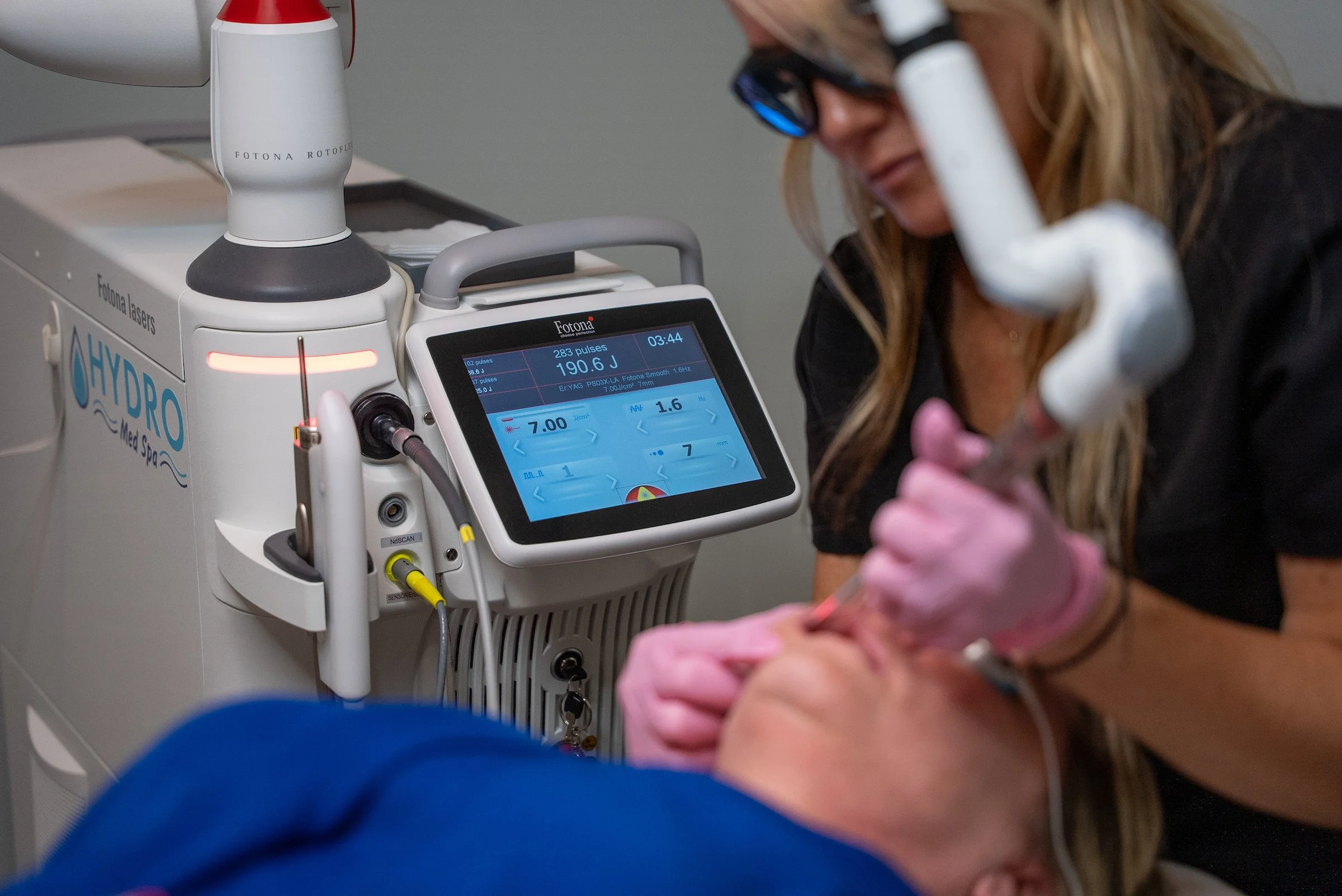
Microneedling VS. Fractional Laser: What’s The Difference?
The biggest difference is how the treatments create controlled stimulation within the skin.
Microneedling uses extremely small sterile needles to create controlled micro-injuries in the skin.
Fractional laser resurfacing uses laser energy to create controlled treatment zones within the skin.
Although the mechanisms are different, both approaches are designed to initiate a natural healing and remodeling response.
That can make either treatment useful for patients interested in improving skin texture, fine lines, pores, acne scarring, and overall skin quality.
But the differences matter.
How Does Microneedling Work?
Microneedling is often referred to as collagen induction therapy.
During treatment, very small sterile needles create controlled microchannels within the skin. This initiates the body's natural wound-healing response and stimulates processes involved in collagen and elastin production and remodeling.
One of the advantages of microneedling is that the treatment can be customized by adjusting treatment depth and technique based on the area being treated and the patient's individual concerns.
Microneedling may be considered for concerns including:
Fine lines
Enlarged pores
Uneven skin texture
Acne scarring
Certain types of scars
Overall skin quality
Early signs of aging
Depending on the treatment performed, patients may experience temporary redness, sensitivity, mild swelling, dryness, or flaking afterward.
For many patients, microneedling provides a way to stimulate the skin without using heat or laser energy.
HOW DOES FRACTIONAL LASER RESURFACING WORK?
Fractional laser resurfacing takes a different approach.
At Hydro Med Spa, we use the Fotona SP Dynamis Pro, an advanced laser platform incorporating both Er:YAG and Nd:YAG wavelengths.
For fractional resurfacing, laser energy is delivered in a controlled pattern rather than uniformly treating every portion of the skin.
This creates microscopic treatment zones while leaving surrounding areas available to assist with the healing process.
One of the advantages of fractional laser technology is the ability to customize the intensity of treatment.
Depending on the patient's skin and goals, treatment can range from lighter resurfacing to more intensive procedures designed to produce a greater degree of skin renewal.
Fractional laser resurfacing may be considered for concerns including:
Fine lines and wrinkles
Acne scars
Enlarged pores
Uneven or rough texture
Sun-damaged skin
Pigmentation concerns
Signs of photoaging
Overall skin rejuvenation
As treatment intensity increases, downtime generally increases as well.
That's why discussing your tolerance for recovery is an important part of choosing the appropriate procedure.
SO, IS LASER STRONGER THAN MICRONEEDLING?
Not necessarily—and this is where online comparisons can become misleading.
It's tempting to put treatments into categories such as:
Microneedling = mild
and
Laser = aggressive
But aesthetic medicine isn't always that simple.
Both treatments can be customized.
A lighter fractional laser treatment is very different from a more aggressive resurfacing procedure. Likewise, microneedling treatment depth and technique can vary considerably.
The goal shouldn't be to choose the most aggressive treatment available.
The goal is to use enough treatment to appropriately address the concern while balancing safety, recovery, and the patient's desired outcome.
More aggressive does not automatically mean better.
WHICH IS BETTER FOR ACNE SCARS?
This is one of the most common reasons patients compare microneedling and fractional laser resurfacing.
And again, there isn't one answer for every patient.
"Acne scarring" isn't a single type of scar.
Patients can have shallow textural irregularities, deeper depressions, rolling scars, boxcar-type scars, ice-pick scars, pigmentation changes, or combinations of several different patterns.
Scar depth and type matter.
Skin characteristics matter.
Previous treatments matter.
And the amount of downtime a patient is willing to accept matters.
Microneedling can be an excellent option for certain acne scars and textural concerns.
Fractional laser resurfacing can also be extremely useful when greater resurfacing or a different depth of treatment is appropriate.
In some cases, treating acne scarring may involve more than one modality over time.
This is exactly why we prefer to evaluate the scar rather than simply treat the word "acne scar."
WHICH IS BETTER FOR FINE LINES AND WRINKLES?
Both treatments can play a role.
If the primary goal is improving early textural changes and stimulating collagen remodeling, microneedling may be appropriate.
If there is more significant photoaging, surface irregularity, or a need for greater resurfacing, fractional laser treatment may be considered.
But wrinkles are also not all the same.
A line caused primarily by repeated muscle movement is different from a fine line associated with collagen loss, and both are different from skin laxity.
That means the best treatment for a wrinkle may not even be microneedling or fractional laser.
Sometimes the most important part of an aesthetic consultation is determining what is actually causing the problem you're trying to fix.
WHAT ABOUT PORES AND SKIN TEXTURE?
Both microneedling and fractional laser resurfacing can be used as part of a treatment strategy for visible pores and uneven skin texture.
Which one we recommend depends on what else we see.
For example, a patient whose primary concern is mild textural irregularity may have a very different treatment plan from someone with significant sun damage, acne scarring, pigmentation, and more advanced signs of aging.
Rather than treating each concern in isolation, we look at the skin as a whole.
WHICH ONE HAS MORE DOWNTIME?
This depends heavily on the intensity of treatment.
Microneedling commonly produces temporary redness and sensitivity followed by a relatively short recovery period, although individual responses vary.
Fractional laser recovery can vary substantially because laser treatments can be performed at different intensities.
A lighter resurfacing treatment may involve relatively modest downtime.
A more intensive treatment may involve several days or longer of redness, swelling, dryness, flaking, peeling, or sensitivity.
This is an important consideration.
Some patients want the greatest amount of improvement possible from an individual procedure and are comfortable with more downtime.
Others need to return to work or social activities quickly and would rather pursue a more gradual treatment strategy.
Neither approach is wrong.
Your lifestyle is part of your treatment plan.
WHICH TREATMENT REQUIRES FEWER SESSIONS?
There isn't a universal number.
Some patients may benefit from a series of microneedling treatments.
Others may benefit from fractional laser treatments performed at appropriate intervals.
Treatment frequency depends on the condition being treated, treatment intensity, response to previous procedures, and the patient's goals.
This is another reason we encourage patients not to shop for skin treatments based only on the price of a single session.
You're not really comparing one appointment to another.
You're comparing treatment strategies.
CAN YOU COMBINE MICRONEEDLING AND LASER?
Potentially.
Skin rejuvenation doesn't have to be an either/or decision.
Different technologies accomplish different things, and a comprehensive skin plan may use different modalities at different points.
That doesn't necessarily mean performing everything at once.
At Hydro Med Spa, we prefer a deliberate approach:
Evaluate → Treat → Heal → Reassess → Adjust
Your treatment plan can evolve as your skin improves.
WHO SHOULD BE CAUTIOUS WITH SKIN RESURFACING?
Not everyone is an appropriate candidate for every procedure.
Your provider should know about your medical history, medications, history of abnormal scarring or keloids, active skin conditions or infections, recent procedures, tendency toward pigmentation changes, and other factors that could affect treatment or healing.
Laser treatments also require careful consideration of skin characteristics, recent sun exposure, tanning, and the specific laser wavelength and settings being used.
This is one reason an in-person skin evaluation is valuable.
A treatment that worked beautifully for your friend—or someone you saw on social media—may not be the treatment we recommend for you.
THE BIGGEST MISTAKE? CHOOSING THE TREATMENT BEFORE EVALUATING THE SKIN
We see patients come in saying:
"I want microneedling."
Or:
"I want laser."
And sometimes they're absolutely right.
But sometimes, after evaluating their skin and discussing what they actually want to improve, we recommend a different approach.
That's an important distinction in how we approach aesthetics at Hydro Med Spa.
We don't want to sell you a procedure. We want to build an appropriate treatment plan.
If microneedling makes the most sense, that's what we'll recommend.
If fractional laser resurfacing makes more sense, we'll discuss that.
If another treatment would better address the problem, we'll tell you that too.
MICRONEEDLING VS. FRACTIONAL LASER: THE BOTTOM LINE
Microneedling and fractional laser resurfacing aren't competing treatments where one has to win.
They're different tools.
Microneedling uses controlled mechanical micro-injury to stimulate the skin's natural repair and remodeling response.
Fractional laser resurfacing uses controlled laser energy to create targeted treatment zones and can provide varying degrees of resurfacing depending on the technology and settings used.
Both may help improve skin texture, fine lines, pores, acne scarring, and overall skin quality in appropriately selected patients.
The right choice depends on:
What you're trying to treat
Your skin characteristics
The severity and depth of the concern
Previous treatments
Your desired outcome
Your tolerance for downtime
Your timeline
Your overall treatment strategy
And sometimes, the answer isn't one or the other.
It may be both—at different points in your skin journey.
DON'T GUESS. BUILD A SKIN PLAN.
If you're considering microneedling or fractional laser resurfacing, you don't need to figure out which procedure you need before scheduling your appointment.
That's what the consultation is for.
At Hydro Med Spa, we'll evaluate your skin, talk about what bothers you, discuss how much downtime you're comfortable with, and help you understand which treatment options make sense for your goals.
And if you're thinking about improving your skin over the next several months, don't make another common mistake:
Waiting until you want the result to start working toward the result.
Fall is an excellent time to begin planning your skin rejuvenation strategy.
Ready to stop guessing?