
Why Does the Neck Age Faster Than the Face? Here's What's Actually Happening
If you've noticed your neck giving away your age before anything on your face does, you're not imagining it.
It's one of the most common things we hear in consultations. Someone is happy with their face, but the neck tells a different story — looser skin, faint horizontal bands, a jawline that photographs sharp from one angle and soft from another.
That's not bad luck. It's biology.
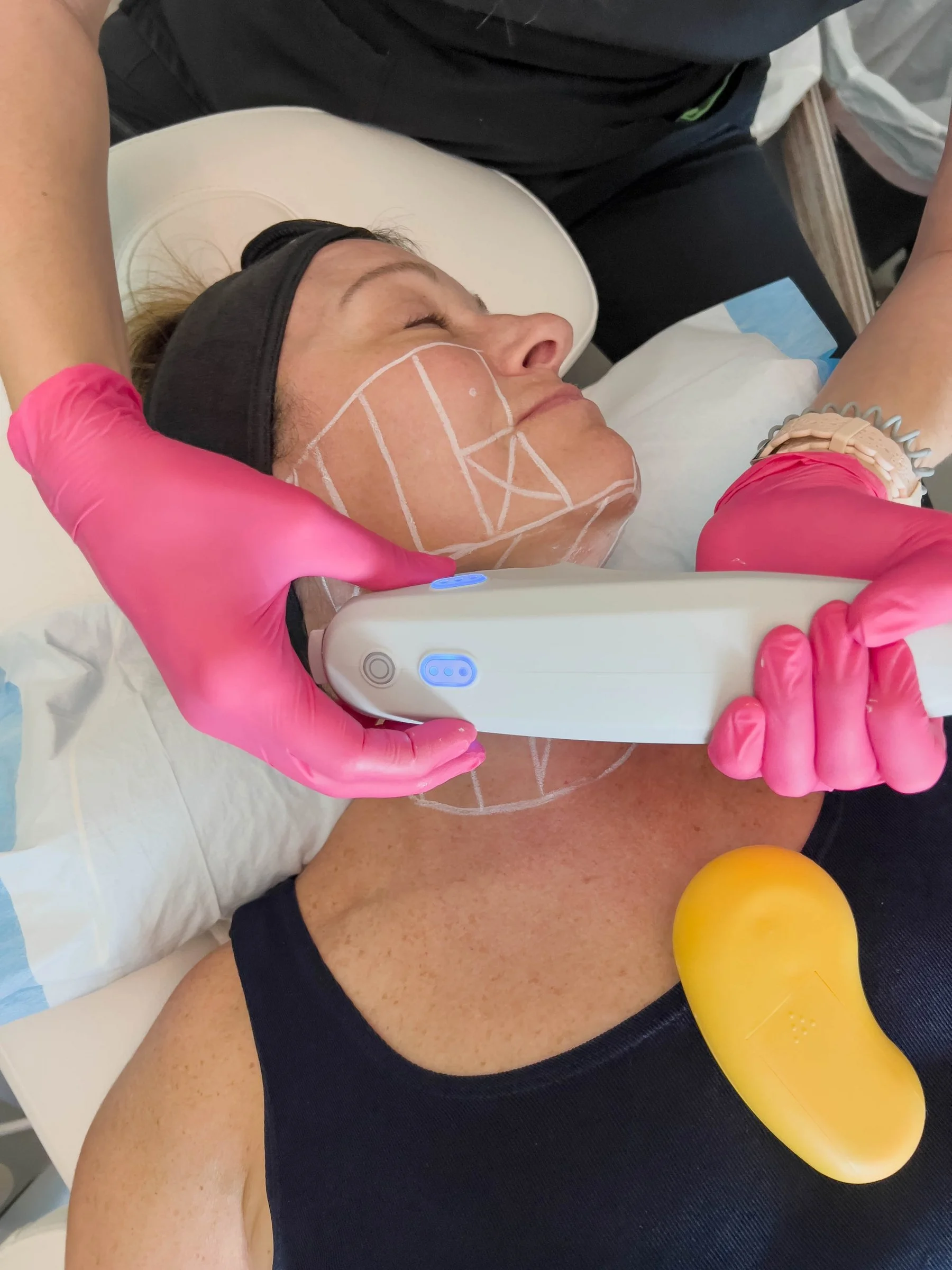
Why the Neck Ages Faster Than the Face
The short answer: the neck has less structural support to begin with, and most people never protect it the way they protect their face.
A few things stack up against it:
Thinner skin. The skin on the neck is thinner than facial skin, with fewer oil glands to keep it hydrated and resilient.
Less underlying fat and muscle support. The face has more fat pads and a denser layer of muscle beneath the skin. The neck relies heavily on the platysma, a thin sheet of muscle that loosens with age and can create the vertical banding some patients notice under the chin.
Constant motion. The neck flexes every time you look down at a phone, a screen, or a book — thousands of times a day, for decades.
Chronic sun exposure that gets skipped. Most people apply sunscreen to their face and forget the neck and chest entirely.
Gravity and time. Collagen and elastin decline throughout the body starting in our mid-20s, but the neck has less reserve to lose before laxity becomes visible.
None of this means the neck is a lost cause. It means it needs a different approach than the face — one that accounts for thinner skin and looser support from the start.
Is It Just Loose Skin, or Something Else?
That's actually the wrong question. Neck aging is rarely just one thing.
By the time someone comes in concerned about their neck, we're usually looking at some combination of:
Skin laxity (the skin itself has lost elasticity)
Platysmal banding (visible vertical cords, especially when tensing the neck)
Loss of jawline definition, sometimes called submental fullness or a “double chin” appearance
Textural changes — crepiness, fine horizontal lines, sun damage
Volume loss along the jawline that makes the neck look heavier by comparison
The better question is: which of these are actually present, and in what proportion? Two people can both say “my neck looks older than I feel,” and need completely different treatment plans.
What Can Actually Help an Aging Neck
This is where we don't want to sell you a procedure. We want to build an appropriate treatment plan — because the right answer depends entirely on what's driving the appearance in the first place.
For skin laxity and early crepiness
Fotona4D is our go-to for this. It combines multiple laser wavelengths, including modes specifically designed to heat the skin's deep support layer and stimulate new collagen production, without surgery or downtime. Results build gradually over the weeks following treatment as that new collagen forms, and a series of sessions is typically recommended for skin laxity along the neck and jawline.
You may also come across ultrasound-based tightening treatments like Ultherapy at other practices, which use focused ultrasound rather than laser energy to reach that same deep layer. We've moved away from offering that technology in favor of Fotona4D, which lets us combine tightening with resurfacing and pigment correction in the same session.
For skin quality, fine lines, and sun damage
Fotona4D's resurfacing modes also work well alongside microneedling, which uses controlled micro-injury to trigger the skin's own collagen response and can improve texture, fine lines, and mild laxity over a series of sessions.
For visible platysmal banding
A small, carefully placed amount of Botox, Dysport, Xeomin, or Jeuveau can soften the appearance of vertical neck bands by relaxing the platysma muscle. This isn't about freezing the neck — it's a targeted, conservative use of neuromodulator that many patients don't realize is an option.
For volume loss along the jaw and lower face
Dermal filler or Radiesse can restore definition along the jawline, which often improves how the neck looks in profile without touching the neck itself. Sculptra, a biostimulator that works gradually over months, is another option for patients looking to rebuild collagen support rather than add volume directly.
For everyday prevention
Medical-grade skincare with retinoids, peptides, and daily SPF on the neck and chest — not just the face — slows down how quickly these changes progress in the first place.
Why This Is a Plan, Not a Single Procedure
Most of the best neck results we see come from combining two or three of these approaches rather than relying on one. Skin tightening with Fotona4D, a conservative touch of neuromodulator for banding, and a medical-grade skincare routine at home tend to work better together than any one of them alone.
This is the approach we take with every patient: Evaluate → Treat → Heal → Reassess → Adjust. We start with an honest look at what's actually happening in your skin, treat conservatively, give your body time to respond, and adjust the plan based on real results — not a one-size-fits-all package.
Frequently Asked Questions
Can you fix a “turkey neck” without surgery? Mild to moderate skin laxity often responds well to non-surgical treatments like Fotona4D, which stimulates the skin's own collagen. More significant, longstanding skin excess may respond better to a surgical consultation — part of an honest evaluation is telling you when non-surgical options aren't the right fit.
How long do neck tightening results last? Results from treatments like Fotona4D typically continue improving for two to three months and can last a year or more, though this varies by individual and by how much ongoing sun exposure and skincare maintenance factor in.
Is Botox for neck bands the same as Botox for wrinkles? The product is the same, but the technique and dosing for platysmal bands is different from treating forehead lines or crow's feet. It should be done by someone experienced specifically with neck anatomy.
When should I start treating my neck? Earlier is easier. Prevention and early intervention — daily SPF, medical-grade skincare, and starting collagen-stimulating treatments before laxity becomes significant — generally produce better long-term results than waiting until the changes are advanced.
Does neck treatment hurt or require downtime? Most of the treatments discussed here — Fotona4D, microneedling, neuromodulator — involve little to no downtime, though mild redness or tenderness for a day or two is common depending on the treatment.
Ready to Find Out What Your Neck Actually Needs?
The neck doesn't need to be ignored, and it doesn't need a one-size-fits-all fix. It needs an honest evaluation and a plan built around what's actually happening in your skin.